
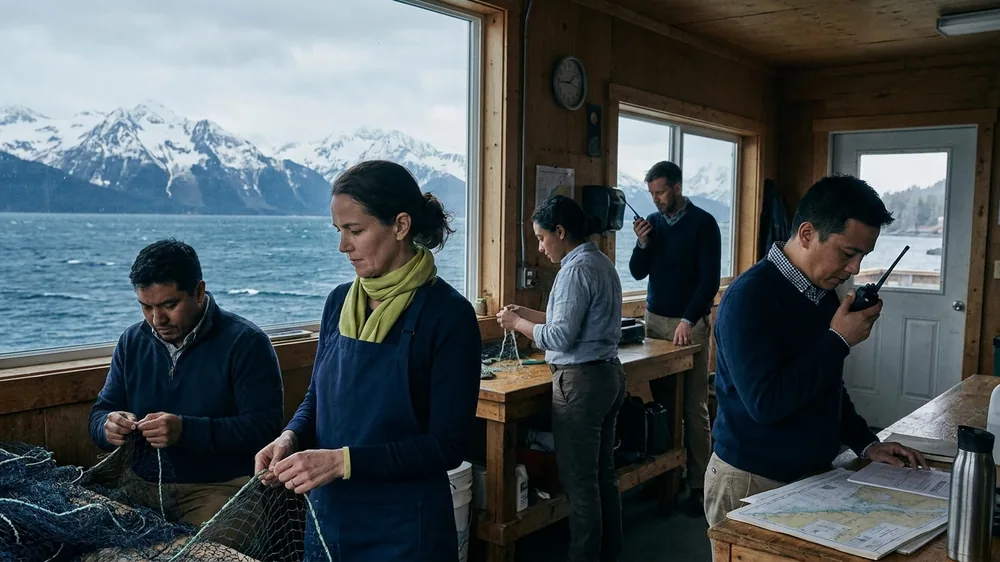
Most business continuity planning is written for a generic office somewhere in the continental US, where the worst-case scenario tends to be a power outage or a flooded basement. If you run a business in Alaska or Hawaii, that planning misses the events you actually have to worry about. An earthquake that knocks out power and damages your building. A volcanic eruption that grounds flights and coats a region in ash. A tsunami warning that empties a coastal town in an afternoon. A wildfire season that threatens whole communities.
These aren’t far-fetched. They’re part of doing business here, and they shape how we think about keeping our clients running. The good news is that the same disasters that feel uniquely difficult also have a clear set of answers, as long as your continuity plan is built for where you actually are rather than copied from somewhere else.
What makes continuity different in Alaska and Hawaii
The events themselves are part of it, but the bigger difference is what happens around them. When something goes wrong here, the distance and isolation that make these places special also slow down recovery in ways a continental US plan never accounts for.
If a server fails or your hardware is damaged, the replacement does not arrive next morning. Shipping to Hawaii can add days even in good conditions, and a disaster makes it worse, a reality we cover in how island shipping delays affect getting replacement IT hardware. In parts of Alaska, the nearest replacement might be a flight away, and flights are exactly what a volcanic ash cloud or a winter storm shuts down. Internet and power can be slower to come back when there are fewer redundant routes feeding a region.
So the planning question is not only “how do we recover,” it is “how do we keep operating when the usual fast fixes are not available for days?” That changes the math, and it is why a continuity plan built for here leans harder on the things that do not depend on physical proximity.
The events, and what each one demands
It helps to think through the specific scenarios, because each one stresses a slightly different part of your operation.
An earthquake is sudden and physical. It can damage the building, knock equipment off racks, and cut power and connectivity all at once, with no warning. The lesson it teaches is that anything depending on a single physical location, including your only server and your only copy of the data, is a single point of failure. Earthquakes are also why we do not assume a backup sitting in the same room as the server is safe.
A volcanic eruption is slower but wider. Ash grounds aircraft, which means hardware and even people cannot move in or out. It can foul equipment and disrupt power over a large area for an extended time. The lesson is logistics. If you cannot get new hardware or a technician on site for a week, your ability to keep working has to live somewhere that does not require either.
A tsunami comes with warning, sometimes only minutes or hours, and forces evacuation of low-lying and coastal areas. The lesson is access from elsewhere. If your team has to leave the building, and possibly the area, can they still reach the systems and data they need to keep serving customers from wherever they end up?
A wildfire can mean evacuation, power shutoffs, and smoke that closes offices for days even when the building survives. The lesson is much the same. Continuity here means being able to work when the physical office is simply not an option for a while.
Across all four, a pattern emerges. The businesses that ride these out are the ones whose ability to operate is not chained to a single building, a single piece of hardware, or the ability to physically reach either one quickly.
Building a plan that fits
A continuity plan for Alaska and Hawaii rests on a few principles that follow directly from those scenarios.
Keep protected copies of your data somewhere other than your building. If your only backup is on site, the earthquake or fire that damages your office can take your recovery option with it. Offsite and cloud copies mean your data survives no matter what happens to the physical location. This is the foundation of how we approach backup and disaster recovery, and it matters even more where physical recovery is slow.
Be able to operate without the office. Cloud-based email, files, and applications mean your team can work from home, from a relative’s house across the island, or from another town entirely if they have to evacuate. The less your daily work depends on hardware that sits in one room, the better you weather a disaster that makes that room unreachable.
Set realistic recovery targets for where you are. The recovery time you can promise depends partly on logistics that are different here, so your targets have to account for that. Thinking through how long you can be down and how much data you can afford to lose is the starting point, and we walk through it in RTO vs RPO explained.
Write the plan down before you need it. In the middle of an evacuation is the worst time to figure out who does what. A simple, written plan that your team has actually seen turns chaos into a checklist. Our Business Continuity / DR Plan Template gives you a structured starting point you can fill in for your own business.
Why local matters here
There is one more piece that does not show up in a generic plan. When a disaster hits Alaska or Hawaii, a provider with no one in the region doesn’t feel what you feel. They’re not under the same ash cloud or evacuation order, and they don’t know that the only flight out was cancelled. We do, because our people are here. Being genuinely local means we understand the conditions, we plan for the logistics that actually apply, and we are part of the same community working through the same event. That perspective is exactly why local presence matters for IT here, which we explore in our regional guide for Alaska and Hawaii.
Where to start
You don’t need a thick binder to begin. Start with one honest question: if our building were unreachable for a week, could we still serve our customers? If the answer is no, the next steps are usually getting your data protected offsite and getting your core work onto systems your team can reach from anywhere.
If you want help building a continuity plan that fits the specific risks of where you operate, that’s a conversation we’re glad to have. We live and work in the same places you do, and we’d rather help you be ready before the next event than help you recover after.