
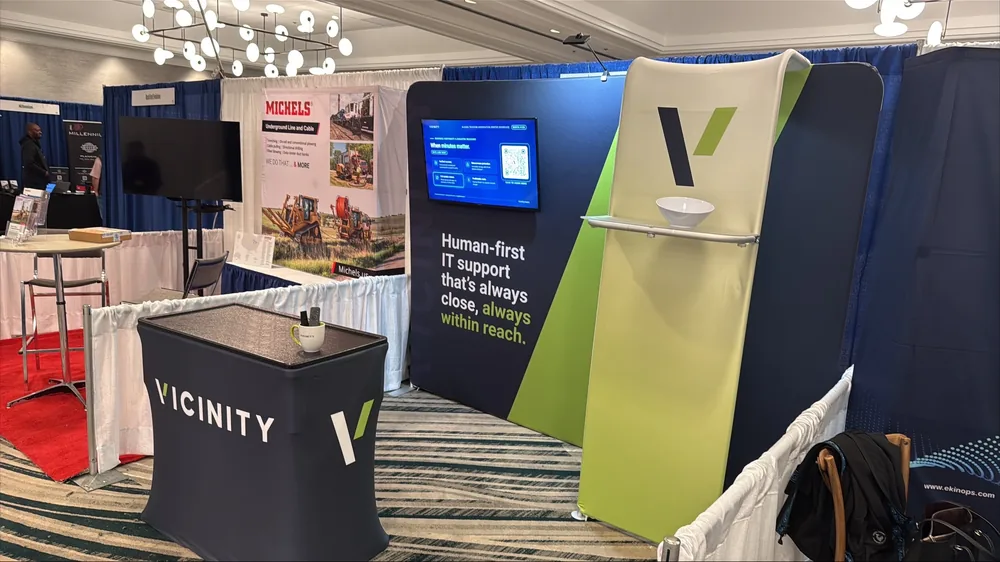
We spent a few days at the Alaska Telecom Association winter showcase in Anchorage this month, and one conversation came up over and over. Business customers keep asking their broadband provider for more than a circuit. They want someone to manage the Microsoft 365 tenant, secure the laptops, handle the backups, and answer the phone when the office is down. The provider would like to say yes. Most have tried, or have looked at trying, and found it harder than expected.
This article is about why that is, and about a different way to get there.
Why managed services are hard for a telecom
The usual explanation is staffing. Good IT engineers are hard to hire in Alaska, and harder to keep. That is true, but it is not the real problem. The real problem is that a managed services practice is a fundamentally different business from a telecom, and it is different in ways that do not show up until you are already running one.
A telecom is an infrastructure business. It is capital intensive, it is regulated, and it is highly technical. The company is organized around building and operating assets: fiber, towers, switching, spectrum, backhaul. Success is measured in subscribers, coverage, uptime, and return on the capital deployed. The brand promises reliability and reach. Customer contact is mostly transactional, and the best outcome for most customers is that they never need to call.
A managed services practice has more in common with a hospitality business or a professional services firm, such as a law or accounting practice, than it does with a telecom. The product is a relationship. Clients are served one at a time, by name, by people who know their office, their software, and their staff. Contact is constant and personal. The best outcome is not silence. It is a client who calls on a Tuesday afternoon because a new hire starts Monday, gets a person who already knows what that means for their setup, and has it handled before they hang up.
Done well, managed services are less about technology than about serving clients who use technology to remove friction from their work. The technology matters, but it is the means, not the product.
That difference runs all the way through the business:
- The metrics are different. Infrastructure businesses track capex efficiency, ARPU, churn, and network availability. A services practice lives on response and resolution times, client satisfaction, technician utilization, the ratio of accounts to engineers, and retention measured per account rather than per subscriber. If the practice is managed with the telecom’s scorecard, it will look wrong even when it is going well.
- The financial profile is different. Margins on managed services are lower than on infrastructure, and the return on invested capital is lower too. Growth comes from hiring and training people, not from laying plant, and people cost roughly the same whether or not the practice is busy. For many telecoms, this is the deciding factor. A dollar spent on infrastructure returns more than a dollar spent building a services practice, and the board knows it.
- The brand and the sales motion are different. Telecom marketing sells capacity, speed, and coverage. Managed services are sold on trust and on a track record of showing up. The messaging, the sales cycle, and the kind of people who sell it well are all different.
- The operating discipline is different. A services practice runs on IT service management: ticket workflows, documentation standards, change control, security baselines, vendor management, and a service desk that behaves the same way at 4:45 on a Friday as it does at 10:00 on a Tuesday. This is a craft of its own, and it takes years to build.
Two businesses, two scorecards
The numbers a telecom runs on and the numbers a managed services practice runs on have no overlap.
Telecom / ISP
Operational
- Network availabilityuptime across the plant, measured in nines
- Coverage and homes passedhow much of the market the network can reach
- Subscribers and connectionscounted by the thousand, not by name
- Mean time to repairhow fast an outage is cleared
- Capacity utilizationhow full the circuits and backhaul are
Financial
- Capex per passingcost to build to each location
- ARPUaverage revenue per user
- Subscriber churnlost connections per month
- EBITDA margintypically high once the plant is built
- Return on invested capitalwhat a dollar of plant earns over its life
Managed services / MSP
Operational
- First response timehow long a client waits for a person
- Resolution time and SLA attainmentper ticket, per client, every week
- Client satisfactionrated on each interaction, by name
- Technician utilizationbillable and productive hours per engineer
- Accounts per engineerhow many clients one person can know well
Financial
- Gross margin per accountafter the labor that serves it
- Monthly recurring revenue per clientcontract value, not usage
- Revenue per engineerthe practice scales with people
- Labor cost ratiopayroll as a share of revenue, usually the largest line
- Retention per accountone lost client is a visible number
None of this means telecoms should stay away from managed services. It means that building the practice from scratch, inside an infrastructure company, is usually the wrong way to get there.
A different model: your relationship, our operation
The alternative is a white-label partnership. The telecom sells managed IT services under its own brand, or co-branded, to its business customers. Vicinity delivers them.
The division of work is simple. You bring the sales relationships, the local presence, and the trust you already have with every business on your network. We bring the IT operations and the service management practice: the service desk, the engineers, the security stack, the backup and recovery, the Microsoft 365 and cloud expertise, the compliance work, and the governed AI adoption program we call Managed Intelligence. We already run this across Alaska, Hawaii, Guam, and American Samoa, and we have partnered before with Alaska companies that bring something we do not have.
Your account team stays in front of the customer. Our people handle the tickets, the projects, and the 2 a.m. incident. The customer sees one provider, one bill, and one relationship, which is what they asked for in the first place.
Why this is worth doing
The case for a telecom to offer managed services has always been about stickiness. A business that gets its circuit, its IT support, and its security from the same provider does not switch carriers over a small price difference. The service layer makes the connectivity layer harder to leave, because leaving means replacing a relationship, not just a contract.
There is a second reason that matters more every year. Businesses are moving their core operations into cloud platforms and, increasingly, into AI tools that depend on them. Every one of those moves consumes more bandwidth, more consistently, than the file server in the back office ever did. A business with a well-run IT practice behind it adopts those tools faster and uses them more. The managed services relationship is what drives that adoption, and the adoption is what drives the next capacity sale. Over-the-top services and the underlying broadband grow each other.
A partnership gives you both of those outcomes without the parts that made the in-house practice a poor fit:
- No capital tied up in a business with lower returns than your network.
- No hiring and training of engineers and service desk staff in a market where they are scarce.
- No second operating model, second set of metrics, or second brand voice to manage.
- Revenue that scales with your sales effort, not with your headcount.
What it looks like in practice
Every partnership is shaped around the telecom’s market and the customers it already serves, but the pattern is consistent. We agree on a service catalog your team can sell, with pricing that works for both sides. We train your account managers on what the services are and who they fit. We handle onboarding, documentation, and day-to-day delivery under agreed service levels. You keep the customer relationship and the billing, and we report to you on how every account is doing.
Who does what in the white-label model
The customer sees one provider. Behind that, the work is split by who is best placed to do it.
A new sale
- 1Business customerAsks their account manager for help with IT, not just the circuit.The request comes to the relationship they already have.
- 2Your account managerScopes the need against the agreed service catalog and quotes it under your brand.Your pricing, your paper, your name on the proposal.
- 3VicinityJoins the scoping call when it is technical, and designs the solution.Your team never has to be the IT expert in the room.
- 4Business customerSigns one agreement with you. Connectivity and managed IT, one contract.One provider, one bill, one number to call.
- 5VicinityOnboards the account: documentation, security baseline, Microsoft 365, backups, monitoring.Delivered to agreed service levels, under your brand.
- 6Your brandBills the customer each month. Vicinity reports to you on how the account is doing.You own the revenue and the relationship. We own the delivery.
A service call
- 1Business customerThe office can't open its files on a Tuesday morning. They call the support number on your branded welcome kit.Same number they call about the circuit.
- 2Vicinity service deskAnswers in your name, pulls up the account, and starts the ticket.Our engineers already know this office, its software, and its staff.
- 3Vicinity engineerFixes it remotely, or dispatches on site when it needs hands.Worked against the same service levels every time, including 4:45 on a Friday.
- 4Business customerBack to work. Gets a ticket summary and a short satisfaction survey, both under your brand.To them, your company just solved the problem.
- 5Your account managerSees the ticket, the resolution time, and the account's health in the reporting we send you.No surprises on the next check-in call.
- 6Your account managerNotices the pattern behind the tickets: the office moved to cloud tools and is straining its circuit. Brings a capacity upgrade.The service relationship surfaces the next connectivity sale.
We also take the same approach with our partners that we take with our clients. We would rather be clear about what fits and what does not than sign something that will not work for your customers. That is a conversation, not a sales deck, and it is the one we were having on the floor in Anchorage.
Where to start
If you are a telecom or broadband provider in Alaska or the Pacific and your business customers are asking for more than connectivity, we would like to talk. We can walk through what a white-label managed services offering would look like for your market, what your team would need to sell it, and what we would commit to on delivery. Contact us to set up a conversation. Our CEO, Justin Burgess, spent the showcase on the expo floor rather than behind the booth, so if you did not catch him there, you can find him on LinkedIn any time.